What Makes Ol Pejeta Conservancy Unique?
What makes Ol Pejeta Conservancy unique? Its exceptional combination of endangered-species protection, Big Five wildlife viewing, immersive conservation activities, community partnerships and innovative land management distinguishes it from conventional safari destinations. Located in Kenya’s Laikipia County, Ol Pejeta gives travelers an opportunity to enjoy an exciting wildlife safari while learning how modern conservation works in practice.
The conservancy is globally associated with rhino protection and is home to Najin and Fatu, the world’s last two known northern white rhinos. It also protects black and southern white rhinos, supports lions, leopards, elephants and buffaloes, and operates the Sweetwaters Chimpanzee Sanctuary for rescued chimpanzees that cannot safely return to the wild.
Ol Pejeta’s appeal extends beyond the animals themselves. Visitors can participate in guided game drives, authorized night safaris, lion tracking, rhino monitoring, bird walks and conservation talks. These experiences help travelers understand the science, fieldwork and community cooperation required to protect wildlife over the long term.
This professional guide from Ngeye Uganda Tours explains what makes Ol Pejeta Conservancy unique, which experiences deserve priority and how to plan a responsible visit. Travelers can also explore our African safari packages and discover complementary destinations through our Kenya national parks guide.
Quick answer: Ol Pejeta is unique because it combines Big Five wildlife viewing with globally significant rhino conservation, Kenya’s Sweetwaters Chimpanzee Sanctuary, hands-on conservation activities, community-development programs, livestock–wildlife integration and varied accommodation in one Laikipia destination.
What Makes Ol Pejeta Different at a Glance?
| Distinctive feature | Why it matters | Visitor experience |
|---|---|---|
| Northern white rhinos | Ol Pejeta protects the last two known members of the subspecies | A controlled educational encounter with their keepers |
| Rhino conservation | Monitoring, security and veterinary work protect threatened rhinos | Rhino identification and monitoring experiences |
| Big Five wildlife | The conservancy supports lion, leopard, elephant, buffalo and rhino | Morning, afternoon, all-day and authorized night drives |
| Chimpanzee sanctuary | Rescued chimpanzees receive long-term care in a protected setting | Conservation education and specialized sanctuary visits |
| Community partnership | Conservation is connected with neighboring communities and livelihoods | A safari with broader social and environmental context |
| Integrated land management | Wildlife, livestock and grassland management are considered together | Educational livestock–wildlife integration experiences |
Why Is Ol Pejeta Globally Important for Rhino Conservation?
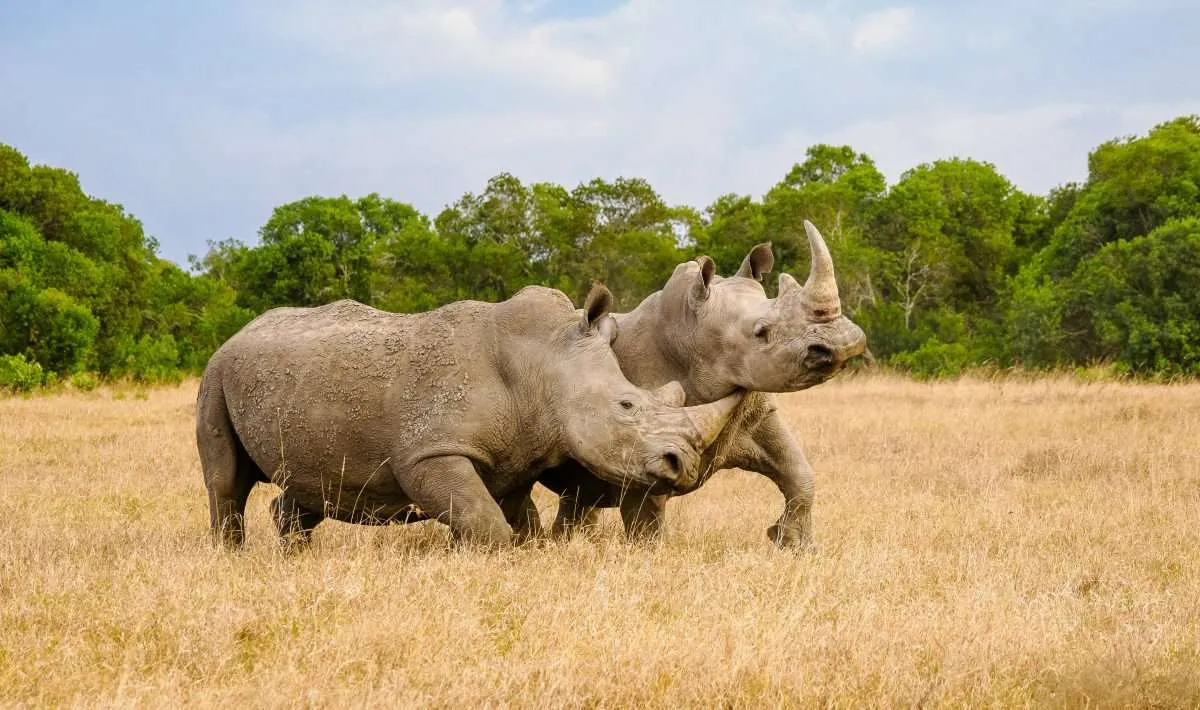
Rhino protection is one of the clearest answers to the question, “What makes Ol Pejeta Conservancy unique?” The conservancy protects black and southern white rhinos through security, field monitoring, habitat management and veterinary support.
Monitoring teams learn to distinguish individual rhinos through features such as horn shape, ear notches, scars and known home ranges. Consistent identification helps conservation personnel record health, reproduction, movement and changes in behavior.
Black and white rhinos occupy different ecological roles. Black rhinos are primarily browsers, feeding on shrubs and woody plants, while white rhinos generally graze. Their names do not accurately describe their skin color; mouth shape, posture and feeding behavior provide more useful identification clues.
Visitors can reserve a rhino-monitoring and identification experience to learn how this fieldwork is conducted. It transforms an ordinary sighting into a deeper lesson about conservation science and the long-term commitment required to protect threatened animals.
The Last Two Northern White Rhinos
Ol Pejeta is home to Najin and Fatu, the last two known northern white rhinos on Earth. Both are female, meaning the subspecies can no longer reproduce naturally. Their story is one of the most powerful reasons why Ol Pejeta has become globally significant.
Scientific teams have continued working on assisted-reproduction approaches using preserved biological material and closely related surrogate animals. The process is complex and should never be described as guaranteeing the recovery of the subspecies.
A guided northern white rhino experience allows visitors to learn from the keepers responsible for their daily care. The encounter communicates the consequences of habitat loss, poaching and delayed conservation intervention in a way that statistics alone cannot achieve.
Access is controlled, and animal welfare takes priority over visitor expectations. Group size, photography rules and permitted interaction can change according to security and operational conditions.
Responsible-travel note: The northern white rhino experience is an educational conservation activity, not an unrestricted animal encounter. Reservations should be made in advance, and every keeper instruction must be followed.
Is Ol Pejeta a Big Five Safari Destination?
Ol Pejeta supports the five species traditionally described as the Big Five: lion, leopard, elephant, buffalo and rhino. This allows visitors to combine conservation education with classic African wildlife viewing.
Lions may be found resting near cover or moving across open areas, while elephants travel between feeding grounds and water sources. Buffaloes occur in herds and smaller groups, and rhino sightings are a central feature of the conservancy.
Leopards are present but naturally elusive. Their camouflage, solitary habits and preference for cover mean sightings require patience and good fortune. No ethical operator should promise that every visitor will observe all five species.
Other wildlife may include giraffes, zebras, hyenas, jackals, warthogs, hartebeests, waterbucks and several other antelope species. Birds, reptiles, insects and smaller mammals add further ecological richness.
What Makes Lion Tracking in Ol Pejeta Different?
Ol Pejeta offers a specialized lion-tracking experience in which participants may accompany a skilled tracker searching for selected radio-collared lions. The activity introduces visitors to the techniques used to monitor predator movement and behavior.
Monitoring information can help conservation personnel understand home ranges, pride structure and the relationship between predators, prey and human activity in the surrounding landscape.
Lion tracking is not designed as a guaranteed close encounter. Radio equipment may help identify a general location, but vegetation, animal movement and access conditions still affect the outcome.
This experience is especially suitable for travelers interested in conservation research, wildlife photography and the practical work behind safari tourism. Spaces may be limited, making advance booking important.
Why Is the Sweetwaters Chimpanzee Sanctuary Unique?
The Sweetwaters Chimpanzee Sanctuary provides refuge and long-term care for rescued chimpanzees. Chimpanzees are not naturally indigenous to Kenya, so the sanctuary must not be promoted as a wild chimpanzee habitat or trekking destination.
Many sanctuary residents have histories associated with illegal wildlife trafficking, habitat destruction or other human-created threats. Because they cannot safely return to the wild, the sanctuary provides a protected environment in which they receive professional care.
A standard visit introduces travelers to the challenges facing chimpanzees and the responsibilities involved in caring for rescued primates. A specialized behind-the-scenes experience may provide additional information about sanctuary operations when available.
Chimpanzees can choose where to move within the protected environment, so visibility varies. The purpose of the experience is conservation education rather than a staged photographic encounter.
Travelers hoping to see wild chimpanzees in their natural rainforest habitat can combine Kenya with Uganda. Ngeye Uganda Tours can create a cross-border journey incorporating Ol Pejeta with professionally guided chimpanzee tracking and gorilla trekking.
What Conservation Experiences Can Visitors Join?
Many safari areas provide game drives, but Ol Pejeta distinguishes itself through guided activities that reveal the work taking place behind wildlife protection. These experiences encourage travelers to become informed participants rather than passive observers.
| Experience | What visitors learn | Planning requirement |
|---|---|---|
| Rhino monitoring | Individual identification, movement and protection | Advance reservation and ranger guidance |
| Lion tracking | Predator research and radio-collar monitoring | Limited availability; sightings are not guaranteed |
| Conservation talk | Wildlife protection, technology and community development | The official conservancy advises advance booking |
| K9 dog tracking | How trained bloodhounds support wildlife security | Participation conditions should be confirmed |
| Livestock–wildlife integration | Grassland, cattle and wildlife management | Subject to schedule and operational availability |
Authorized Night Game Drives
Ol Pejeta officially offers night game drives, giving travelers an opportunity to experience the conservancy after sunset. Cooler temperatures and darkness change the activity of many species, revealing behaviors that may not be seen during ordinary daytime drives.
Possible encounters may include hyenas, jackals, bushbabies, hares and nocturnal birds. Lions and leopards may also be active, although neither should be guaranteed.
Night drives must be conducted as authorized guided activities. Visitors should not attempt independent after-dark exploration or leave their accommodation without professional guidance.
Responsible guides use controlled lighting and avoid prolonged disturbance. Participants must remain quiet, avoid flash photography unless permitted and follow every safety instruction.
Guided Bush and Bird Walks
Guided walking activities reveal the smaller details of Ol Pejeta’s ecosystem. Participants may examine tracks, droppings, plants, insects and bird calls that are easily overlooked from a safari vehicle.
The conservancy’s combination of grassland, woodland, wetlands and riverine vegetation supports varied birdlife. Raptors, water-associated birds, grassland species and woodland birds may be encountered depending on season and habitat.
Walking in wildlife country must take place only within authorized areas under professional supervision. A ranger selects an appropriate route according to wildlife movement, weather and current safety conditions.
These walks are particularly valuable for birdwatchers, families with eligible children and travelers interested in ecology rather than concentrating exclusively on the Big Five.
What Is Livestock–Wildlife Integration?
Another feature that makes Ol Pejeta unusual is its livestock–wildlife integration model. The conservancy manages cattle alongside wildlife as part of a wider approach to land and grassland management.
Carefully controlled grazing can influence vegetation structure and create changing habitat conditions across the landscape. The model demonstrates that conservation involves soil, water, grass, livestock, wildlife and livelihoods rather than focusing on animals in isolation.
A specialized educational experience introduces visitors to this approach. It is particularly relevant to agricultural groups, conservation students and travelers interested in sustainable land management.
The presence of livestock should therefore not be misunderstood as conflicting automatically with conservation. Ol Pejeta uses management, monitoring and planning to integrate different land-use objectives.
How Does Ol Pejeta Work with Local Communities?
Wildlife conservation is difficult to sustain when neighboring communities receive no benefit from protected landscapes. Ol Pejeta therefore connects conservation with community development through partnerships that support livelihoods, education, healthcare and local infrastructure.
The conservancy’s current official information states that its community department works directly and indirectly with people in designated neighboring communities. This approach recognizes that local residents are essential stakeholders in the future of wildlife.
Community development can strengthen conservation by improving cooperation, reducing conflict and demonstrating that living wildlife can provide long-term social and economic value.
Visitors should approach community programs with respect. Local people should not be treated as attractions, and photographs should only be taken with informed permission.
Why Is the Landscape of Ol Pejeta Special?
Ol Pejeta lies within the Laikipia landscape, where open grasslands, acacia-dotted plains, wooded sections, dams, wetlands and riverine habitats create varied wildlife environments.
Mount Kenya may appear in the distance when visibility is clear, adding a dramatic backdrop to the conservancy. It should be described as a possible view rather than a daily guarantee because cloud and weather can obscure the mountain.
Different habitats support different species. Open areas favor grazing animals, wooded sections provide browsing and concealment, and water sources attract wildlife during dry conditions.
This variety also benefits photographers. Changing landscapes, morning mist, dust, storm clouds and golden evening light can produce images that communicate more than a close portrait of one animal.
Does Ol Pejeta Offer Different Accommodation Styles?
Travelers can choose from intimate luxury camps, classic safari lodges, exclusive cottages, budget accommodation and designated wilderness campsites. This range allows Ol Pejeta to serve honeymooners, families, photographers, groups and visitors managing different budgets.
Staying inside the conservancy can reduce travel time between accommodation and activities. It also enables visitors to experience early mornings and quiet evenings within the wildlife landscape.
Accommodation packages differ. Some include game drives and meals, while specialized activities, conservancy fees, drinks and private vehicles may cost extra. A detailed written quotation should clarify every inclusion.
Those staying outside the conservancy should consider transfer times, entry procedures and the schedule of any reserved activities before choosing accommodation based only on room price.
When Is the Best Time to Visit Ol Pejeta?
Ol Pejeta can be visited throughout the year. The generally drier periods from January to February and June to October are popular because roads may be easier to navigate, vegetation can be shorter and animals may gather near dependable water sources.
Greener periods bring fresh vegetation, dramatic skies, interesting bird activity and fewer visitors. Rain can occasionally affect roads and walking activities, but it may also produce beautiful photography conditions.
No season guarantees particular wildlife or uninterrupted sunshine. Climate patterns vary, and responsible planning should include some flexibility.
Travelers visiting during Christmas, Easter and other high-demand periods should reserve accommodation and specialized activities early.
How Many Days Should You Spend in Ol Pejeta?
Two nights offer a useful introduction, providing time for several game drives and one or two conservation-focused activities. Three nights are better for travelers interested in lion tracking, rhino monitoring, birding, a night drive or slower photography.
A day trip can introduce the conservancy, but travel time and activity schedules may limit the experience. Visitors should avoid placing too many specialized tours into a single day.
Ol Pejeta combines well with Mount Kenya, Samburu, Lake Nakuru, Lake Naivasha and the Maasai Mara. Travelers planning a longer journey can consider the 13-Day Kenya Diverse Ecosystems Safari, 14-Day Kenya National Parks Safari or 14-Day Kenya Premium Safari.
What Should You Pack for Ol Pejeta?
Pack lightweight neutral-colored clothing for daytime activities and warm layers for early mornings, evenings and night drives. Laikipia’s elevation can make open-vehicle safaris cooler than many travelers expect.
Comfortable closed shoes, a hat, sunscreen, insect repellent, personal medication and a light waterproof jacket are useful. Binoculars improve wildlife and bird observations, while a zoom lens helps photographers maintain responsible distances.
A reusable water bottle and power bank can also be convenient. Travelers using domestic flights should confirm baggage limits and consider soft-sided luggage.
Why Choose Ngeye Uganda Tours for an Ol Pejeta Safari?
Ngeye Uganda Tours designs personalized East African safaris that combine wildlife, conservation, comfort and responsible travel. We select activities according to each client’s interests rather than placing every traveler on the same itinerary.
Our team can coordinate accommodation, road transfers, domestic flights, professional guiding and specialized reservations. We also confirm current schedules and requirements for experiences such as lion tracking, rhino monitoring and authorized night drives.
Families receive guidance on age restrictions and suitable accommodation, while photographers can request private vehicles and additional time in the field. Travelers interested in primates can combine Kenya with gorilla trekking and wild chimpanzee tracking in Uganda.
Explore our safari packages, learn more about Ngeye Uganda Tours or request a tailored itinerary through our contact page.
Experience What Makes Ol Pejeta Unique
Combine Big Five wildlife viewing, rhino conservation and carefully selected accommodation in a personalized Kenyan safari.
Frequently Asked Questions About Ol Pejeta Conservancy
What makes Ol Pejeta Conservancy unique?
Ol Pejeta combines Big Five wildlife, internationally important rhino conservation, rescued chimpanzee care, specialized conservation activities, community partnerships and integrated land management.
Does Ol Pejeta have the Big Five?
Yes. Lions, leopards, elephants, buffaloes and rhinos are present, although no individual wildlife sighting can be guaranteed.
Why is Ol Pejeta famous for rhinos?
The conservancy protects black and southern white rhinos and is home to Najin and Fatu, the world’s last two known northern white rhinos.
Are the chimpanzees at Ol Pejeta wild?
No. Chimpanzees are not indigenous to Kenya. Sweetwaters Chimpanzee Sanctuary provides protected, long-term care for rescued chimpanzees that cannot safely return to the wild.
Can visitors join conservation activities?
Yes. Experiences may include rhino monitoring, lion tracking, conservation talks, dog tracking and livestock–wildlife education, subject to availability and advance reservations.
Are night game drives allowed?
Yes. Ol Pejeta offers authorized guided night drives. Visitors should not attempt independent after-dark exploration.
What is the best time to visit Ol Pejeta?
The generally drier periods are popular for wildlife viewing, while greener periods provide lush scenery, active birdlife and fewer visitors. Ol Pejeta can be visited throughout the year.
How many nights should I spend in Ol Pejeta?
Two nights provide a useful introduction, while three nights allow a more relaxed combination of wildlife viewing, conservation experiences and birding.