African Elephant: Species, Behavior, Conservation and Safari Guide
Few wildlife encounters communicate the scale and beauty of Africa as powerfully as watching an elephant herd cross an open plain. Adults move with quiet confidence while calves remain close to their mothers, occasionally disappearing beneath the bodies of protective relatives. Whether encountered beside a Kenyan waterhole, along Uganda’s Kazinga Channel, in Tanzania’s great wildernesses, or among the wetlands of Rwanda’s Akagera National Park, African elephants create some of the continent’s most memorable safari moments.
The term “African elephant” refers to two recognized species: the African savanna elephant, scientifically known as Loxodonta africana, and the smaller African forest elephant, Loxodonta cyclotis. Most elephants observed on traditional East African game drives are savanna elephants. Forest elephants primarily occupy the dense forests of Central and West Africa and are much more difficult to observe.
African elephants are remarkable not only because of their immense size. They live in complex societies, communicate through sounds that include low-frequency rumbles, maintain long-term relationships, care for vulnerable calves, remember important landscapes, and respond to changing environmental conditions. Their feeding and movement also modify vegetation, disperse seeds, open pathways, and influence access to water.
Despite their ecological and tourism importance, elephants face serious threats from habitat loss, fragmentation, ivory poaching, human–wildlife conflict, and the obstruction of traditional movement routes. An ethical elephant safari should therefore provide more than close photographs. It should deepen understanding of elephant behavior while supporting protected areas and communities that coexist with wildlife.
This comprehensive guide from Ngeye Uganda Tours explores African elephant species, anatomy, family life, communication, diet, reproduction, ecological importance, conservation challenges, safari safety, and the finest destinations for responsible elephant viewing across East Africa.
African elephant at a glance: Africa has two recognized elephant species: the African savanna elephant and the African forest elephant. Both are highly intelligent, socially complex, ecologically important, and threatened by human activities. Most elephant safaris in Kenya, Uganda, Tanzania, and Rwanda focus on the African savanna elephant.
Are There Two Species of African Elephant?
Yes. Scientific evidence supports the recognition of two separate African elephant species rather than a single species with regional variations. They differ genetically and physically, and they occupy different principal habitats.
| Feature | African Savanna Elephant | African Forest Elephant |
|---|---|---|
| Scientific name | Loxodonta africana | Loxodonta cyclotis |
| Typical size | Generally larger and heavier | Generally smaller and more compact |
| Primary habitat | Savannah, grassland, woodland, floodplain, and semi-arid ecosystems | Dense tropical forests, especially in the Congo Basin |
| Tusk shape | Often curves outward | Usually straighter and points downward |
| Safari visibility | Frequently observed in many East and Southern African parks | Difficult to observe because of dense forest habitat |
| Conservation status | Listed as Endangered by the IUCN | Listed as Critically Endangered by the IUCN |
The elephants seen in Amboseli, Tsavo, Samburu, the Maasai Mara, Queen Elizabeth, Murchison Falls, Serengeti, Tarangire, Ruaha, and Akagera are African savanna elephants. The forest elephant is more closely associated with Central and West African forests and should not be presented as a common East African game-drive species.
How Large Is an African Elephant?
The African savanna elephant is the world’s largest living land animal. Adult males can be significantly larger than females, although body size varies with age, genetics, habitat, nutrition, and local conditions. Forest elephants are smaller but remain immensely powerful animals.
An elephant’s enormous body is supported by strong, pillar-like legs. Despite their weight, elephants can move quietly, navigate rough terrain, cross rivers, climb slopes, and travel substantial distances in search of food and water.
Their large ears help release body heat and are also used during communication and displays. Ear shape, tears, holes, vein patterns, tusks, scars, and other features can help researchers and experienced guides identify individual elephants.
Size can be difficult to appreciate from inside a safari vehicle. Only when an adult elephant walks past a large tree, vehicle, or smaller animal does its true scale become apparent. Visitors should never interpret a calm appearance as permission to approach closely. Elephants can move rapidly and change behavior when they feel pressured.
How Does an Elephant Use Its Trunk?
The elephant’s trunk is an extraordinary combination of the nose and upper lip. It contains thousands of muscles and performs tasks requiring both immense strength and delicate control.
Elephants use their trunks to smell, breathe, touch, communicate, gather food, drink, spray water, throw dust, investigate objects, greet companions, reassure calves, and defend themselves. A trunk can pull down a branch and also pick up a small item with remarkable precision.
Elephants do not drink directly through their trunks as if using straws. They draw water into the trunk and then release it into the mouth. They may also spray water over their bodies before covering themselves with mud or dust.
Trunk position can communicate mood and intention, but interpretation requires context. A raised trunk may indicate scent investigation, while a curled or rapidly moving trunk can form part of alert or defensive behavior. Guides consider the elephant’s ears, head, feet, tail, vocalizations, and the behavior of the wider herd before drawing conclusions.
Why Do African Elephants Have Tusks?
Tusks are elongated upper incisor teeth that grow throughout much of an elephant’s life. Elephants use them to strip bark, dig for water or minerals, move vegetation, lift objects, defend themselves, and compete with rivals.
Tusk size and shape vary according to genetics, age, sex, nutrition, and past damage. An elephant may break part of a tusk during feeding, fighting, digging, or other activities. Some elephants naturally develop very small tusks or no visible tusks.
Because ivory is made from dentine, the same principal material found beneath the enamel of human teeth, removing an elephant’s tusk is not harmless. A substantial portion extends into the skull, and obtaining the full tusk generally requires killing the elephant.
Illegal demand for ivory has caused enormous losses in elephant populations and disrupted family and social structures. Travelers should never buy ivory products, even when sellers claim they are old, legal, or naturally collected. International and domestic laws vary, and purchasing ivory perpetuates demand.
How Do African Elephant Families Live?
Elephant society is strongly shaped by long-term family relationships. A typical family unit includes related adult females and their offspring. The group is often guided by an experienced older female known as the matriarch.
The matriarch’s knowledge can be particularly valuable during droughts, threats, seasonal movements, and encounters with unfamiliar animals or people. She may remember water sources, movement routes, dangerous locations, and relationships with other elephants.
Females often remain connected to their maternal families throughout their lives. Related family groups may separate and reunite, creating a wider and flexible social network rather than a permanently fixed herd.
Young males gradually become more independent as they mature. They may travel alone or associate with other males. Older bulls can play an important social role by influencing younger males and demonstrating appropriate behavior.
Visitors sometimes assume that every collection of elephants is a single permanent herd. In reality, gatherings around rivers, waterholes, or productive feeding areas may contain several families and independent males that temporarily share the same location.
How Do Elephants Care for Their Calves?
Elephant calves are born after one of the longest gestation periods among mammals—approximately 22 months. A newborn must quickly learn to stand, walk, follow its family, and use its trunk.
Calves are protected not only by their mothers but also by other females, sometimes described as allomothers. These helpers may guide, comfort, guard, or supervise young elephants while gaining experience that can benefit them when raising their own calves.
During a possible threat, adults may gather around a calf, placing larger bodies between the vulnerable youngster and the source of concern. Safari vehicles must give family groups additional space, particularly when calves are very young.
Young elephants learn by observing, touching, playing, and interacting. They practice manipulating plants, following social signals, controlling their trunks, crossing difficult ground, and responding to the movements of the herd.
How Do African Elephants Communicate?
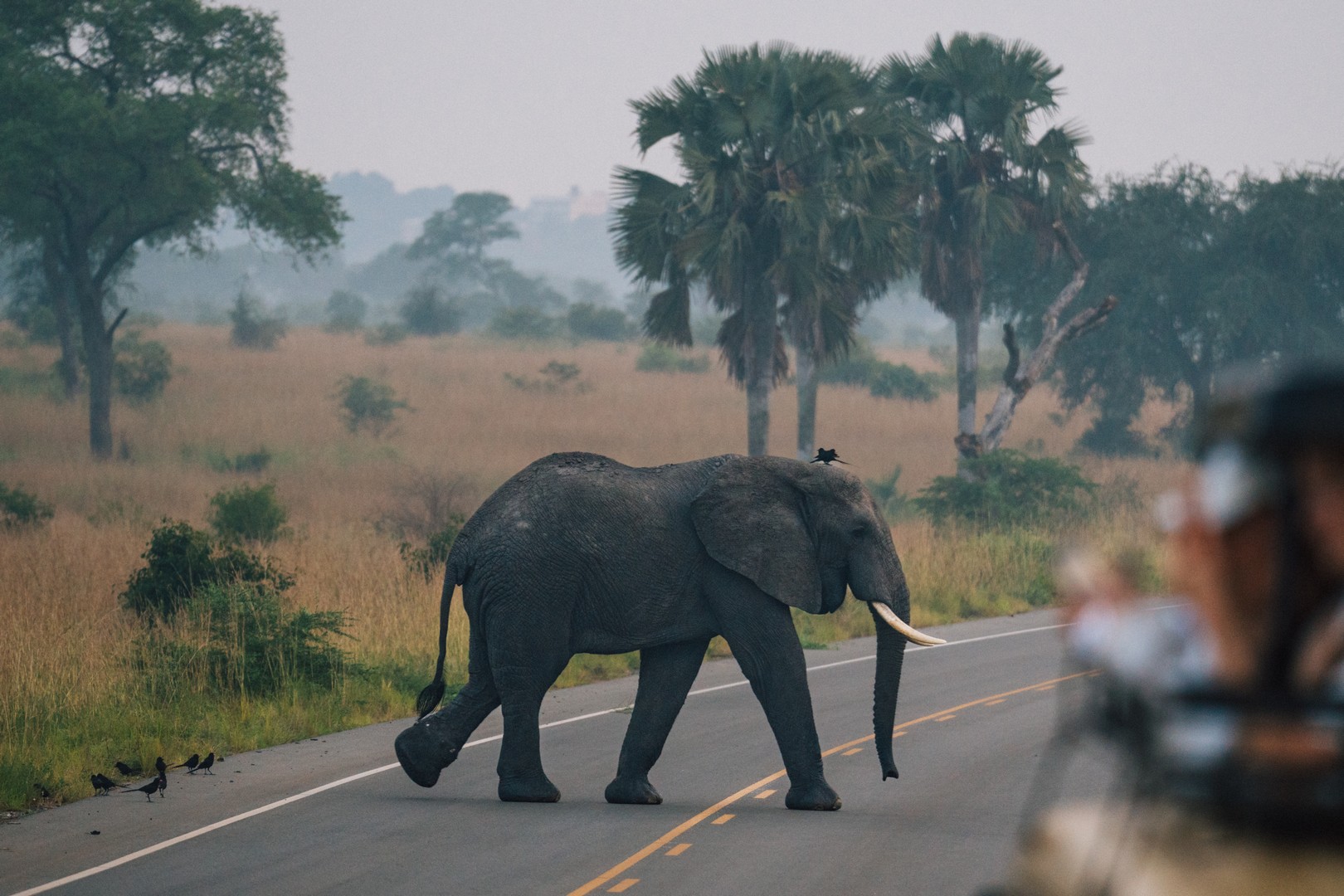
Elephants communicate through sound, touch, scent, posture, body movement, and vibrations transmitted through the ground. Their vocal range includes trumpets, roars, snorts, and low-frequency rumbles.
Some rumbles travel over substantial distances and may be below or near the lower limit of human hearing. Elephants can detect these signals through their ears and may also respond to vibrations through sensitive structures in their feet and trunks.
Touch plays an important role in reassurance and social bonding. Elephants may place trunks in one another’s mouths, touch faces, lean against companions, greet returning family members, or comfort distressed individuals.
Ear position, head height, trunk movement, tail posture, urination, vocalization, dust throwing, and foot movement can provide clues about an elephant’s state. However, one signal should never be interpreted in isolation. Safari guides evaluate the full situation, including the presence of calves and whether the animal has an open escape route.
Are African Elephants Intelligent?
African elephants display sophisticated learning, memory, problem-solving, cooperation, social recognition, and behavioral flexibility. Their ability to remember landscapes and relationships is especially important for animals that may travel across extensive and changing environments.
Elephants can distinguish between individuals, respond differently to familiar and unfamiliar calls, coordinate group movement, learn from experienced companions, and modify behavior in response to perceived threats.
Observers have recorded elephants showing strong interest in injured, distressed, dying, or dead companions. These behaviors are sometimes described using human terms such as grief or mourning. While such descriptions may help people relate emotionally, scientists remain careful about assigning exact human emotions without sufficient evidence.
What is clear is that elephants possess complex social awareness. The removal of mature individuals through poaching or conflict can therefore affect more than population numbers; it can disrupt knowledge, relationships, leadership, and social stability.
What Do African Elephants Eat?
African elephants are herbivores with diverse diets. Depending on habitat and season, they consume grasses, leaves, branches, bark, roots, fruit, seeds, and aquatic vegetation.
They spend much of the day feeding because their large bodies require substantial nutrition. Diet changes as rainfall, plant growth, fruiting, fires, drought, and water availability alter the landscape.
Elephants use their trunks to gather vegetation and their tusks to strip bark or dig. Their powerful molars grind fibrous plant material. These teeth are replaced in sequence during an elephant’s lifetime; severe dental wear in old age can eventually limit the animal’s ability to feed effectively.
Feeding elephants may knock down branches, strip bark, push over trees, open dense vegetation, or create paths used by other wildlife. These effects can benefit certain species while reducing cover or food for others. Ecological influence therefore depends on elephant density, rainfall, vegetation, fire, available space, and other environmental factors.
Why Are Elephants Called Ecosystem Engineers?
African elephants are often described as ecosystem engineers because their feeding, movement, and digging physically change habitats. These modifications influence plants, water, other animals, and ecological processes.
By opening pathways through dense vegetation, elephants can create access for smaller species. Digging for water may expose moisture used by other animals, while depressions and footprints can temporarily collect rainwater.
Seeds consumed with fruit may pass through the digestive system and be deposited far from the parent plant together with nutrient-rich dung. This makes elephants important seed dispersers, particularly in forest ecosystems.
Elephant dung also supports insects, fungi, birds, and other organisms. Nutrients are returned to the soil, demonstrating how one large animal can influence many smaller forms of life.
However, describing every landscape change as automatically beneficial oversimplifies ecology. Where elephants become concentrated in restricted areas without sufficient movement space, their impact on trees and vegetation may create difficult management questions. Healthy wildlife corridors and large connected landscapes are therefore extremely important.
Why Are Tsavo Elephants Red?
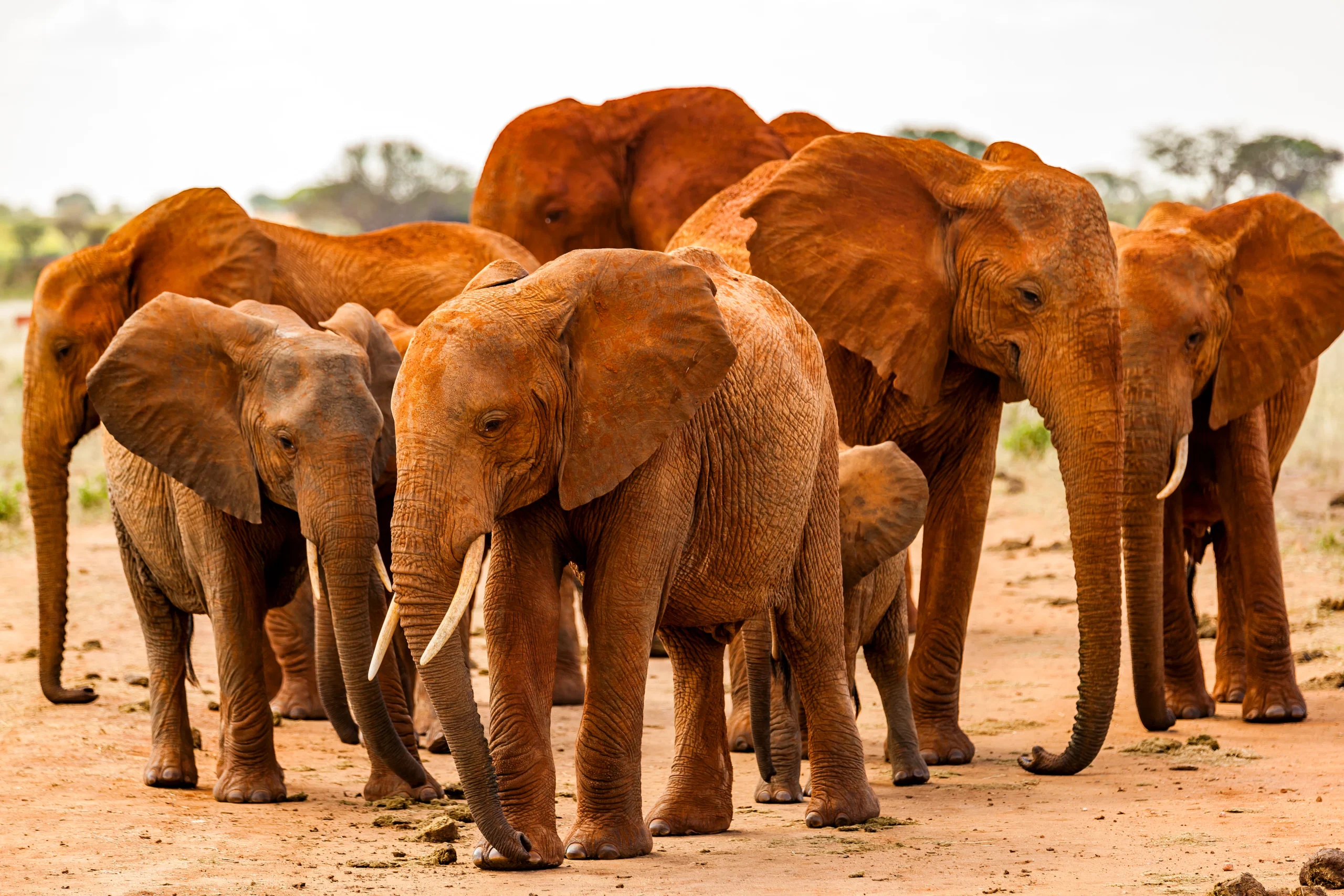
The elephants of Tsavo are not naturally a separate red-colored species. Their distinctive appearance results from dust bathing in the region’s iron-rich red soil.
Elephants use their trunks to throw dust and soil over their bodies. This behavior can help protect the skin from sunlight, insects, and moisture loss. Mud bathing may provide additional cooling and skin protection.
The soil gradually coats the elephant’s gray skin, producing the famous red or rust-colored appearance associated with Tsavo East and Tsavo West. In areas with pale, brown, or volcanic soil, elephants may appear to take on different shades.
Where Do African Elephants Live?
African elephants occupy diverse habitats across parts of sub-Saharan Africa. Savanna elephants use grasslands, open woodland, scrub, floodplains, wetlands, and semi-arid environments. Forest elephants are adapted to dense tropical forests, particularly within the Congo Basin.
Elephants frequently move beyond the boundaries of individual national parks. They may cross community land, conservancies, private ranches, forests, farmland, roads, and international borders while following water, food, seasonal conditions, and inherited movement routes.
Effective conservation must therefore protect connected landscapes rather than isolated parks alone. A protected area surrounded by blocked corridors may not provide enough space for seasonal elephant movement.
Tsavo: Where Can Travelers See Kenya’s Red Elephants?
Tsavo East and Tsavo West together form one of Kenya’s most extensive elephant landscapes. Tsavo East is particularly associated with broad horizons, the Galana River, semi-arid plains, and elephants coated in red dust.
The region’s size creates a strong sense of wilderness, although wildlife may be more dispersed than in smaller parks. Visitors should value the landscape and natural searching process instead of expecting every drive to produce close encounters.
Tsavo West introduces volcanic features, wooded areas, hills, lava flows, and springs. Combining the two parks reveals how elephants use different habitats within a wider ecosystem.
Explore Tsavo, Amboseli, Samburu, the Maasai Mara, and other destinations through the Ngeye Kenya national parks guide.
Amboseli: Can You Photograph Elephants with Mount Kilimanjaro?
Amboseli National Park is one of Africa’s most celebrated elephant-viewing destinations. Its open terrain, wetlands, and surrounding ecosystem support well-known elephant families and create excellent opportunities for behavioral observation.
On clear days, Mount Kilimanjaro creates a spectacular background. However, the mountain is frequently obscured by clouds or haze, and unobstructed views cannot be guaranteed. Early mornings sometimes provide favorable conditions.
Photography should never interfere with elephant movement. Vehicles must avoid blocking a herd’s route to water or separating calves from adults simply to create a Kilimanjaro composition.
Samburu: What Makes Elephant Viewing in Northern Kenya Special?
Samburu National Reserve and its surrounding conservancies provide a distinctive elephant experience shaped by dry-country scenery and the Ewaso Nyiro River.
Elephants may gather along the river to drink, feed, rest, cross, or cool themselves. Riverine woodland and doum palms create a beautiful contrast with the surrounding semi-arid landscape.
The wider ecosystem also supports the northern species known as the Samburu Special Five, allowing elephant viewing to be combined with searches for Grevy’s zebras, reticulated giraffes, gerenuks, Beisa oryx, and Somali ostriches.
Queen Elizabeth National Park: Where Can You See Elephants in Uganda?
Queen Elizabeth National Park contains a varied mosaic of savannah, woodland, wetlands, crater areas, and channels. Elephants may be encountered during game drives and along the Kazinga Channel.
A boat safari offers a different viewing perspective as elephants sometimes approach the water to drink, bathe, or feed. Boats must maintain responsible distances and avoid cutting across animals entering or leaving the channel.
The park can be combined with chimpanzee tracking in Kibale, gorilla trekking in Bwindi, and additional wildlife destinations. Explore the possibilities through the Uganda national parks collection.
Murchison Falls and Kidepo: Where Else Can You See Uganda’s Elephants?
Murchison Falls National Park offers elephant sightings across northern savannahs and along the Nile. Game drives can be combined with a boat journey toward the falls, creating opportunities to observe terrestrial and water-associated wildlife.
Kidepo Valley National Park provides a more remote experience surrounded by mountains and broad valleys. Elephant sightings occur within a dramatic and less heavily visited landscape, although the long journey or domestic flight requires careful planning.
Neither park should be presented as guaranteeing close elephant encounters. Their value comes from the complete wilderness experience, varied scenery, and range of wildlife.
Serengeti and Tarangire: Where Can You See Elephants in Tanzania?
The Serengeti ecosystem is best known for its extensive plains and the Great Migration, but elephants also occupy woodland, riverine, and mixed habitats within the wider landscape.
Elephants are not always evenly distributed across the Serengeti. Their location changes with food, water, rainfall, disturbance, and seasonal movement. Visitors should not assume that the most famous open plains always provide the strongest elephant viewing.
Tarangire National Park is particularly renowned for elephants, especially during drier periods when wildlife uses the Tarangire River and other dependable water sources. Ancient baobab trees and varied woodland create one of Tanzania’s most memorable elephant settings.
Ruaha and Nyerere National Parks also protect substantial elephant habitat and provide expansive wilderness experiences. Discover these regions through the Tanzania national parks guide.
Akagera National Park: Can Travelers See Elephants in Rwanda?
Yes. Akagera National Park provides Rwanda’s principal savannah safari and supports elephants within a landscape of grassland, woodland, wetlands, lakes, and rolling hills.
Elephants may be encountered on game drives or near water, although visibility depends on vegetation, location, weather, and animal movement. Akagera offers a valuable contrast to Rwanda’s rainforest and mountain-gorilla experiences.
Combining Akagera with Volcanoes National Park or Nyungwe creates an itinerary covering savannah wildlife and primate-rich forests. Explore Rwanda’s protected landscapes through the Rwanda national parks collection.
Best East African Destinations for Elephant Safaris
| Destination | Country | Elephant-Safari Character |
|---|---|---|
| Amboseli National Park | Kenya | Open landscapes, wetlands, known elephant families, and possible Kilimanjaro views |
| Tsavo ecosystem | Kenya | Immense wilderness and elephants covered in distinctive red soil |
| Samburu ecosystem | Kenya | Dry-country scenery, riverine habitats, and northern Kenya wildlife |
| Queen Elizabeth National Park | Uganda | Game drives and possible waterside encounters along the Kazinga Channel |
| Murchison Falls National Park | Uganda | Savannah elephant viewing combined with Nile boat experiences |
| Tarangire National Park | Tanzania | Elephant gatherings, baobab landscapes, and productive dry-season viewing |
| Serengeti ecosystem | Tanzania | Elephants in woodland and riverine habitats within a vast wildlife landscape |
| Akagera National Park | Rwanda | Savannah, woodland, lakes, wetlands, and a strong conservation story |
When Is the Best Time to See African Elephants?
Elephants can be seen throughout the year in many East African parks. The best period depends on the selected destination and the type of experience a traveler wants.
During generally drier months, vegetation may become shorter and elephants often visit rivers, wetlands, springs, and waterholes. These conditions can make herds easier to locate. Roads may also be more accessible, although popular parks can receive more visitors.
Greener periods create lush scenery, dramatic skies, active birdlife, and seasonal food. Elephants may disperse more widely because water and vegetation become available across a larger area. This can make searching more challenging but creates beautiful photographic conditions.
Rainfall patterns vary between Kenya, Uganda, Tanzania, and Rwanda and have become less predictable. Travelers should avoid treating June to October or January to February as universally dry across every East African destination.
How Should Travelers Behave Around Wild Elephants?
Elephants are intelligent and often peaceful, but they are immensely powerful wild animals. They may react defensively when surprised, crowded, blocked, separated from family members, or approached while protecting calves.
Safari vehicles should stop at a respectful distance and provide an open escape route. Drivers must never position a vehicle between a mother and calf or block animals attempting to reach water.
Travelers should remain quiet, avoid sudden movement, keep body parts inside the vehicle, and follow the guide’s instructions. Attempting to attract an elephant’s attention for a photograph is unsafe and unethical.
Warning behavior can include head lifting, ear spreading, trunk curling, dust throwing, vocalization, mock charging, or changes in posture. However, behavior varies, and visitors should never attempt to judge whether a charge is “real.” Creating distance early is safer than waiting for escalation.
Essential safety rule: Never leave a vehicle near elephants unless you are in an authorized area and accompanied by qualified personnel. An elephant that appears calm can react rapidly if it feels threatened or restricted.
What Threats Face African Elephants?
Ivory poaching remains a major threat, particularly where enforcement is weak and illegal demand persists. Killing a mature elephant also removes ecological knowledge, family leadership, reproductive potential, and social relationships.
Habitat loss and fragmentation reduce the space available for elephants to feed, find water, reproduce, and move seasonally. Farms, fences, roads, settlements, mining, logging, and other developments may obstruct inherited routes.
Human–elephant conflict occurs when elephants enter farms, damage crops, threaten food security, damage property, or cause injury and death. Communities living beside wildlife may carry substantial costs, making fair conservation benefits and effective conflict-reduction measures essential.
Drought and changing rainfall can intensify competition for water and food. Where elephants are compressed into limited protected areas, ecological pressure may create difficult management decisions.
Conservation requires law enforcement, demand reduction, protected habitats, wildlife corridors, research, community participation, early-warning systems, responsible land-use planning, and practical support for affected households.
How Does Responsible Tourism Help Elephant Conservation?
Well-managed safari tourism can finance protected-area operations, ranger teams, ecological monitoring, research, guides, community enterprises, employment, accommodation, transportation, and conservation education.
Tourism is not automatically beneficial. Crowded sightings, irresponsible off-road driving, blocked movement routes, noisy vehicles, poorly located developments, and unequal distribution of income can create additional pressure.
Travelers should choose operators that respect wildlife-viewing regulations, employ professional guides, support local economies, and maintain realistic expectations. Ethical elephant encounters observe animals in natural habitats without touching, feeding, riding, bathing, or forcing interaction.
Facilities promoting direct contact with elephants require careful scrutiny. Terms such as “sanctuary,” “rescue,” or “conservation” should not be accepted without examining animal welfare, handling practices, breeding, visitor contact, and long-term care.
What Should You Pack for an African Elephant Safari?
Pack breathable clothing in neutral colors, together with a warm layer for early mornings and evenings. A sun hat, sunglasses, sunscreen, insect repellent, comfortable footwear, and reusable water bottle are useful across most destinations.
Binoculars improve distant observation and allow travelers to examine social behavior without demanding a closer vehicle position. Photographers should carry a suitable zoom lens, spare batteries, memory cards, charging equipment, and protection against dust.
Travelers using light aircraft must confirm baggage allowances and may need soft-sided luggage. Medication, documents, valuables, and essential personal items should remain in hand luggage within the permitted limit.
Why Choose Ngeye Uganda Tours for an African Elephant Safari?
Ngeye Uganda Tours designs personalized wildlife journeys across Kenya, Uganda, Tanzania, and Rwanda. We select destinations according to season, available time, accommodation preference, budget, photographic interests, mobility, and the other experiences travelers want to include.
An elephant-focused journey can combine Amboseli and Tsavo, Samburu and Ol Pejeta, Queen Elizabeth and Bwindi, Murchison Falls and Kidepo, Tarangire and Serengeti, or Akagera and Rwanda’s primate destinations.
We cannot guarantee elephant sightings, close encounters, particular herd sizes, bathing behavior, calves, or unrestricted mountain views. Instead, we provide informed planning, experienced guides, suitable wildlife habitats, responsible observation, and realistic expectations.
Browse our African safari packages, learn more about Ngeye Uganda Tours, or contact our team for a customized journey.
Plan Your African Elephant Safari
Discover East Africa’s great elephant landscapes through responsible wildlife viewing, professional guiding, and an itinerary designed around your interests.
Frequently Asked Questions About African Elephants
How many species of African elephant are there?
There are two recognized species: the African savanna elephant, Loxodonta africana, and the African forest elephant, Loxodonta cyclotis.
Which African elephant is the largest?
The African savanna elephant is larger than the African forest elephant and is the world’s largest living land animal.
What do African elephants eat?
African elephants eat grasses, leaves, branches, bark, roots, fruits, seeds, and other plant materials. Their diet changes according to habitat and season.
How long is an elephant’s pregnancy?
An elephant’s gestation lasts approximately 22 months, making it one of the longest pregnancies among mammals.
Why do elephants throw dust on themselves?
Dust bathing can help protect elephant skin from sunlight, insects, and moisture loss. Mud may also assist with cooling and skin protection.
Why do Tsavo elephants look red?
Tsavo elephants have naturally gray skin, but bathing in the region’s iron-rich soil gives them a distinctive red or rust-colored appearance.
Where is the best place to see elephants in East Africa?
Excellent destinations include Amboseli, Tsavo, Samburu, Queen Elizabeth, Murchison Falls, Kidepo Valley, Tarangire, Serengeti, Ruaha, Nyerere, and Akagera. Every sighting remains dependent on natural movement.
Are African elephants dangerous?
Elephants can be dangerous when surprised, threatened, crowded, or protecting calves. Travelers must maintain appropriate distances and follow professional guide instructions.
Are elephant sightings guaranteed on safari?
No. Elephants are free-ranging wild animals. Visiting suitable habitats with an experienced guide improves the opportunity, but a particular sighting or behavior cannot be guaranteed.
Can tourists ride African elephants?
Elephant riding is not a natural wildlife encounter and raises significant welfare concerns. Responsible safaris observe elephants living freely in their natural habitats without forced physical interaction.