What Animals Live in Nairobi National Park?
What animals live in Nairobi National Park? Despite being located beside Kenya’s busy capital, Nairobi National Park supports an impressive variety of wild animals, including lions, black and white rhinos, buffaloes, Masai giraffes, plains zebras, spotted hyenas, elands, hartebeests, impalas and numerous smaller mammals. Leopards, cheetahs and servals also occur, although these secretive predators are considerably more difficult to find.
Established in 1946 as Kenya’s first national park, this approximately 117-square-kilometre protected area offers a genuine safari experience within easy reach of the city. Open grasslands, acacia woodland, seasonal streams, wetlands and riverine habitats support different animal communities, allowing visitors to experience surprising biodiversity within a relatively compact landscape.
The park is particularly important for rhinoceros conservation and is considered one of Kenya’s rewarding destinations for travelers hoping to observe endangered black rhinos. However, Nairobi National Park is generally described as a Big Four rather than a complete Big Five destination because wild elephants are not normally resident there.
Its convenient location makes the park suitable for half-day excursions, full-day wildlife safaris and carefully planned airport layover tours. It can also provide an excellent introduction to destinations featured in our Kenya national parks guide. With knowledgeable planning from Ngeye Uganda Tours, travelers can explore Nairobi’s wildlife independently or combine the park with a longer East African safari.
Nairobi National Park Wildlife at a Glance
| Wildlife Category | Animals You May See | Viewing Expectations |
|---|---|---|
| Large predators | Lions, leopards, cheetahs and spotted hyenas | Lions may be seen regularly, but leopards and cheetahs are more elusive. |
| Rhinos | Black and white rhinos | The park is an important rhino conservation area, although sightings are never guaranteed. |
| Large herbivores | Buffaloes, giraffes, zebras, elands and hartebeests | Often observed on open plains or near productive grazing areas. |
| Antelopes | Impala, waterbuck, gazelles and other antelope species | Distribution changes according to habitat, rainfall and water availability. |
| Smaller mammals | Warthogs, jackals, mongooses, baboons and vervet monkeys | Frequently overlooked when visitors concentrate only on larger animals. |
| Birdlife | Raptors, cranes, ostriches, waterbirds and grassland birds | More than 400 resident and migratory species have been recorded in the park environment. |
Which Big Animals Live in Nairobi National Park?
African Lions
Lions are among the most exciting animals living in Nairobi National Park. They may be seen resting in long grass, walking along tracks or watching herds from a distance. Early morning can be especially productive because lions may still be active after hunting or patrolling their territories during the night.
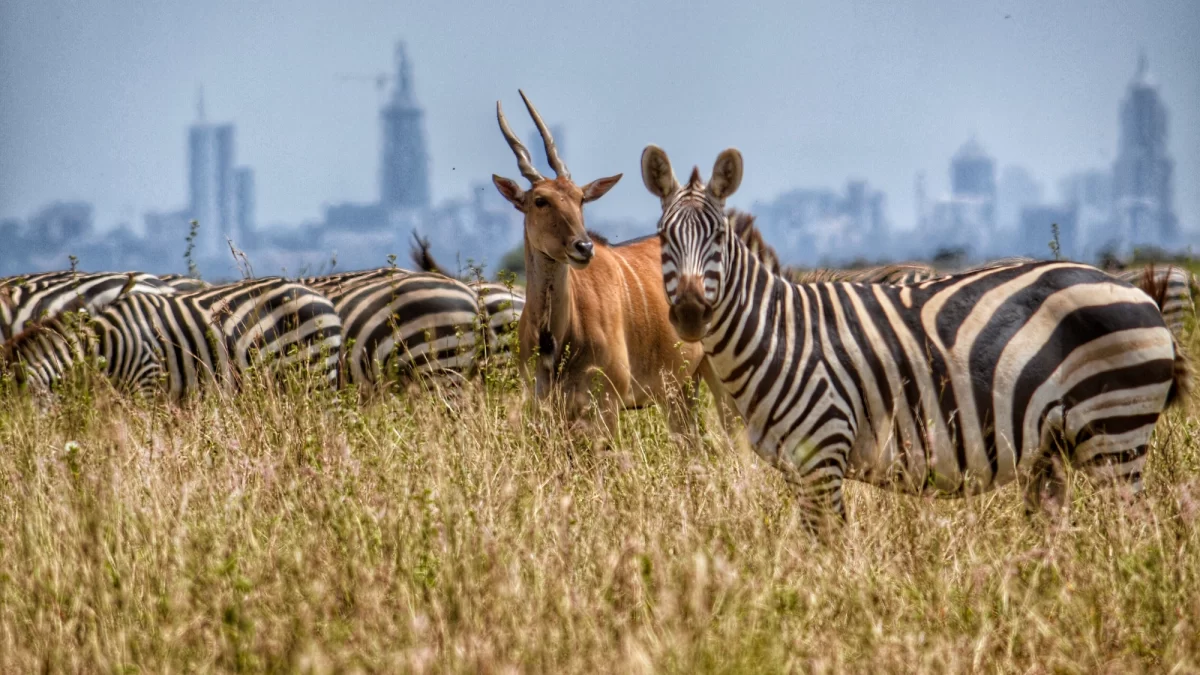
Observing a lion with Nairobi’s skyline in the distance creates one of the park’s most memorable scenes. Nevertheless, the view depends on the animal’s position, the selected route, weather and visibility. Neither lions nor skyline photographs can be guaranteed on every excursion.
Black and White Rhinos
Nairobi National Park is particularly significant for rhinoceros conservation. Both black and white rhinos may be encountered, although they have different feeding behaviors and habitat preferences.
Black rhinos are mainly browsers, feeding on leaves, shoots and woody vegetation. They are often associated with bushier areas and can be more secretive. White rhinos are predominantly grazers and may be found in more open grassland.
Despite their names, both species are grey. The distinction is based primarily on physical features, especially the shape of the mouth. White rhinos have broad, square lips adapted for grazing, while black rhinos possess pointed, prehensile upper lips that help them browse vegetation.
African Buffaloes
African buffaloes form part of Nairobi National Park’s Big Four wildlife. They may appear alone, in small groups or in larger herds. Their movements are influenced by grazing quality, water availability and seasonal conditions.
Buffaloes deserve considerable respect because they are powerful and unpredictable wild animals. Visitors must remain inside their safari vehicle and follow instructions from their guide whenever buffaloes are nearby.
Masai Giraffes
Masai giraffes are among the park’s most photogenic residents. Their irregular, leaf-shaped coat patterns help distinguish them from other giraffe subspecies found across Africa. They commonly browse acacia trees and other woody vegetation.
Their height allows them to reach leaves inaccessible to many smaller herbivores. Giraffes also play an ecological role by influencing vegetation and dispersing seeds through the landscape.
Plains Zebras
Plains zebras are frequently observed grazing across open areas. Every zebra has a distinctive stripe pattern, providing individual recognition within the herd. Their strong social relationships and alert behavior make them fascinating animals to watch.
Zebras may associate with other herbivores, creating mixed groups that increase vigilance against predators. Their presence contributes to the classic savannah scenery for which Kenyan safaris are renowned.
Elands and Hartebeests
Elands, the world’s largest antelopes, occur in Nairobi National Park and may be observed moving through grassland or lightly wooded areas. Despite their size, they are capable of remarkable agility.
Coke’s hartebeests are another characteristic herbivore. Their elongated faces, sloping backs and distinctive horns make them relatively easy to identify. Both species form part of the prey base supporting the park’s carnivores.
Which Predators Live in Nairobi National Park?
Lions are the most visible large predators, but the park supports several other carnivores. Spotted hyenas play an important ecological role as both hunters and scavengers. Their powerful jaws allow them to consume material that many other predators leave behind, helping recycle nutrients through the ecosystem.
Black-backed jackals may be observed moving across open areas or searching for smaller prey. Mongooses and other small carnivores occupy specialized ecological niches and contribute to the park’s biodiversity.
Leopards occur but are secretive, primarily active when conditions are quiet and often concealed by vegetation. Cheetahs may occasionally be encountered in open habitat, while servals can inhabit areas with suitable grass cover and small prey. These animals should be considered special sightings rather than expected features of every game drive.
A knowledgeable guide improves the chances of finding predators by examining tracks, listening to alarm calls and understanding wildlife movements. However, responsible safari operators should never guarantee any particular predator sighting.
Are There Elephants in Nairobi National Park?
Wild elephants are not normally resident in Nairobi National Park. This means that the park is generally regarded as a Big Four destination rather than a Big Five destination. Visitors can potentially encounter lions, leopards, buffaloes and rhinos, but they should not expect wild elephants during an ordinary game drive.
The park’s compact size, surrounding urban development and ecological requirements make it unsuitable for maintaining a resident elephant population comparable with those in Kenya’s larger protected areas.
Travelers hoping to see elephants can combine Nairobi with Amboseli National Park, Tsavo East, Tsavo West, Samburu or the Maasai Mara. Amboseli is particularly well known for its elephant herds and views of Mount Kilimanjaro, while Tsavo protects one of Kenya’s most extensive elephant landscapes.
Important distinction: The nearby Sheldrick Wildlife Trust nursery may care for orphaned young elephants, but it is a separate conservation facility. Its presence near the park does not mean that wild elephants ordinarily live inside Nairobi National Park.
What Antelopes and Grazing Animals Live in the Park?
Nairobi National Park’s grasslands support a varied herbivore community. In addition to zebras, elands and hartebeests, travelers may encounter impalas, gazelles and waterbucks. These species use different feeding strategies, helping reduce competition for the same vegetation.
Grazers concentrate primarily on grasses, while browsers feed on leaves, shoots and shrubs. Some species combine both strategies according to seasonal conditions. This variety allows the park to sustain numerous herbivores within a relatively compact area.
Warthogs may be seen kneeling as they graze or running with their tails raised. Olive baboons and vervet monkeys inhabit suitable woodland and riverine areas, although their distribution varies throughout the park.
Herbivores are central to the ecosystem. They influence plant growth, disperse seeds and support predators. Watching their alert behavior can also help visitors locate carnivores, as sudden alarm calls or focused attention may indicate a predator nearby.
What Birds Live in Nairobi National Park?
Nairobi National Park is one of Kenya’s most accessible birdwatching destinations. More than 400 bird species have been recorded across its open grasslands, acacia woodland, wetlands, dams and seasonal streams.
Secretarybirds may be observed striding through grassland in search of insects, reptiles and small mammals. Ostriches are among the park’s most conspicuous birds, while grey crowned cranes add striking color and elegance to wet grassland areas.
Raptors may include martial eagles, augur buzzards and other birds of prey. Wetland habitats can attract herons, egrets, kingfishers, lapwings and additional water-associated species. Migratory birds add seasonal diversity when conditions are favorable.
A birding-focused game drive is usually slower than a general wildlife excursion. The guide may stop frequently to identify calls, scan trees and examine wetland margins. Early morning offers favorable light, cooler conditions and increased bird activity.
Are There Reptiles and Smaller Animals in Nairobi National Park?
Although large mammals attract the greatest attention, reptiles, amphibians, insects and other small organisms are essential components of the park’s ecosystem. Snakes, lizards and tortoises may inhabit suitable areas, although many remain concealed and are not commonly seen during vehicle-based game drives.
Frogs and other amphibians become more active around wetlands and temporary pools during wetter periods. Butterflies, beetles and pollinating insects support plant reproduction and provide food for birds, reptiles and small mammals.
Termite mounds are another important landscape feature. They create shelter and feeding opportunities while improving soil structure. Looking beyond the large mammals gives travelers a more complete understanding of how the park functions.
How Do Nairobi National Park’s Habitats Support Wildlife?
The answer to “What animals live in Nairobi National Park?” is closely connected to the variety of habitats within its boundaries. Open grasslands support zebras, hartebeests, elands and hunting predators. Acacia woodland provides food and shelter for giraffes, browsers and numerous bird species.
Wetlands, dams and seasonal streams attract animals seeking water while supporting waterbirds, amphibians and aquatic life. Riverine vegetation provides cover for secretive species and creates movement corridors through the landscape.
The park’s southern area has historically connected with the wider Athi-Kapiti plains, allowing some animals to move according to rainfall and grazing conditions. Urban growth, fencing, infrastructure and changing land use have increased pressure on these dispersal areas, making corridor conservation critically important.
Nairobi National Park demonstrates why isolated wildlife populations cannot be understood only by examining the land within official boundaries. The surrounding landscape also affects migration, breeding, feeding and long-term ecological health.
When Is the Best Time to See Animals in Nairobi National Park?
The park can be visited throughout the year, but wildlife-viewing conditions change with rainfall, vegetation and water availability.
Drier Seasons
Conditions are commonly drier from June to October and from January to February. Vegetation may be shorter, allowing visitors to see animals more easily. Wildlife may also gather around dependable water sources.
Road conditions are generally easier during dry periods, but dust can increase. Weather patterns are variable, and occasional rainfall can still occur.
Green and Rainy Seasons
Rainfall commonly increases between March and May and again around November and December. The landscape becomes greener, skies can be dramatic and young animals may sometimes be observed.
Birding can be particularly rewarding during green periods because seasonal conditions support increased activity and visiting migratory species. However, taller vegetation may conceal some mammals, and heavy rainfall can affect certain tracks.
Best Time of Day
Early morning is normally preferred because temperatures are cooler and many animals are more active. Predators may still be moving after the night, while bird calls and activity are often strongest after sunrise.
Late afternoon can also be rewarding as temperatures fall. Visitors must observe current park opening hours and allow sufficient time to reach the correct exit gate.
How Long Do You Need to Explore Nairobi National Park?
Half-Day Safari
A half-day game drive provides a useful introduction for travelers with limited time. It works particularly well when scheduled early in the morning. However, it will not cover every part of the park or guarantee sightings of all major species.
Full-Day Safari
A full day gives visitors more time to explore different habitats, photograph wildlife and wait at promising locations. This option is recommended for birdwatchers and travelers who prefer a relaxed experience.
Two Separate Game Drives
Two drives on different days or at different times allow visitors to experience changing weather, light and wildlife behavior. This approach can benefit specialist photographers and dedicated birdwatchers.
Can You Combine Nairobi National Park with Other Destinations?
Nairobi National Park can easily become the beginning or conclusion of a longer Kenya safari. Travelers may continue to Amboseli for elephants and Mount Kilimanjaro scenery, Lake Nakuru for rhinos and Rift Valley birdlife, Samburu for northern Kenya’s distinctive species or the Maasai Mara for extensive plains and predator viewing.
Separate Nairobi attractions can also be added when time permits. These include the Sheldrick Wildlife Trust’s Nairobi nursery, the Giraffe Centre, Karen Blixen Museum and the National Museum of Kenya. Each attraction has separate admission arrangements and may require advance reservations.
Our available safari packages can be customized according to travel dates, interests, accommodation preference and available time.
Responsible Wildlife Viewing in Nairobi National Park
Visitors should remain inside their vehicles except at officially authorized locations. Wildlife must never be fed, touched, surrounded or called to attract attention. Drivers should maintain a respectful distance and avoid blocking animals’ direction of travel.
Noise should be minimized, particularly near resting predators and nervous herbivores. Litter must be removed or placed in approved containers. Drone use should never be assumed to be permitted without specific authorization.
Wildlife sightings are natural and cannot be guaranteed. Respectful observation protects animals while creating a more authentic safari experience for visitors.
Why Choose Ngeye Uganda Tours for Nairobi National Park?
Ngeye Uganda Tours organizes personalized East African journeys designed around travelers’ interests, available time and preferred comfort level. Nairobi National Park can be arranged as a private half-day safari, full-day excursion or part of a longer multi-destination itinerary.
Experienced guides improve the experience by interpreting animal behavior, identifying birds, examining tracks and selecting routes according to current conditions. Careful scheduling also helps account for Nairobi traffic, park access procedures and onward travel arrangements.
No ethical safari operator can guarantee particular animals. Our approach prioritizes realistic advice, responsible wildlife viewing, suitable transportation and informed local guidance.
Contact Ngeye Uganda Tours to arrange a customized Nairobi National Park safari or connect Nairobi with other destinations across Kenya, Uganda, Rwanda and Tanzania.
Frequently Asked Questions About Nairobi National Park Animals
What animals live in Nairobi National Park?
The park supports lions, black and white rhinos, buffaloes, giraffes, zebras, elands, hartebeests, impalas, gazelles, warthogs, hyenas, jackals, baboons and numerous smaller species. Leopards, cheetahs and servals also occur but are more elusive.
Are there elephants in Nairobi National Park?
Wild elephants are not normally resident in the park. Visitors seeking elephants should combine Nairobi with Amboseli, Tsavo, Samburu or another appropriate Kenyan destination.
Is Nairobi National Park home to the Big Five?
It is generally regarded as a Big Four destination because lions, leopards, buffaloes and rhinos occur, while wild elephants are normally absent.
Can you see lions in Nairobi National Park?
Lions live in the park and may be observed during game drives. However, their movements are natural, and sightings cannot be guaranteed.
Can you see rhinos in Nairobi National Park?
Both black and white rhinos may be encountered. The park is particularly important for rhino conservation, but sightings still depend on natural wildlife movements.
Are there leopards in Nairobi National Park?
Leopards occur in the park but are secretive and difficult to locate. Seeing one should be regarded as an exceptional sighting.
How many bird species live in Nairobi National Park?
More than 400 resident and migratory bird species have been recorded in the park environment, although the number present or visible changes seasonally.
What is the best time to see animals?
Wildlife can be observed year-round. Drier periods may provide shorter vegetation and easier viewing, while wetter months offer green landscapes and rewarding birdwatching.
How long should I spend in the park?
A half-day provides an introduction, while a full day allows more extensive wildlife viewing, birding and photography.
Are animal sightings guaranteed?
No. Nairobi National Park is a natural ecosystem, so sightings depend on animal movement, weather, vegetation, water availability and time of day.