What Wildlife Can I See in Tsavo East National Park?
Tsavo East National Park offers one of Kenya’s most expansive and authentic wildlife experiences. Its immense red-earth plains, seasonal rivers, rocky formations, acacia scrub, and dramatic horizons support an impressive variety of animals, from enormous elephant herds to elusive predators and specialized dry-country species.
The park is particularly famous for African savanna elephants that appear red after covering their naturally gray skin with Tsavo’s iron-rich soil. Lions, buffaloes, Masai giraffes, plains zebras, antelopes, hippos, crocodiles, and hundreds of bird species also contribute to the richness of the ecosystem.
However, Tsavo East differs from smaller reserves where animals may be concentrated within a limited viewing area. The park covers an enormous landscape, and wildlife can be widely dispersed according to water, food, rainfall, temperature, fire, and seasonal movement. This creates a genuine wilderness experience in which patient searching forms an important part of every game drive.
Travelers should therefore arrive with curiosity rather than a fixed checklist. Some drives may produce remarkable elephant encounters, while others reveal giraffes moving through scrubland, a distant lion pride, river wildlife, unusual antelopes, or fascinating birds and smaller animals.
This detailed guide from Ngeye Uganda Tours explains the mammals, predators, river species, birds, reptiles, and smaller creatures that travelers may encounter while exploring Tsavo East National Park.
Quick answer: Wildlife in Tsavo East includes African savanna elephants, lions, buffaloes, Masai giraffes, plains zebras, hippos, crocodiles, waterbucks, impalas, elands, lesser kudus, gerenuks, gazelles, hartebeests, hyenas, jackals, cheetahs, leopards, and diverse birdlife. Sightings depend entirely on natural movement and local conditions.
Tsavo East Wildlife at a Glance
| Wildlife Group | Possible Species | Viewing Expectations |
|---|---|---|
| Large mammals | Elephants, buffaloes, giraffes, zebras, hippos, and elands | Elephants and plains herbivores may be encountered, but distribution changes seasonally |
| Large predators | Lions, leopards, cheetahs, and spotted hyenas | Present but naturally unpredictable; leopards and cheetahs can be particularly elusive |
| Antelopes | Impalas, waterbucks, lesser kudus, gerenuks, gazelles, hartebeests, oryx, and dik-diks | Species vary according to habitat, water, and the section of the park explored |
| River wildlife | Hippos, Nile crocodiles, elephants, waterbucks, monkeys, and waterbirds | Associated with the Galana River and other dependable water areas |
| Smaller carnivores | Jackals, mongooses, genets, civets, servals, caracals, and bat-eared foxes | Often overlooked and generally more challenging to observe |
| Birdlife | Raptors, hornbills, storks, kingfishers, bee-eaters, ostriches, bustards, and waterbirds | Rewarding throughout the year, with seasonal variation and migrant species |
Why Is Tsavo East Famous for Red Elephants?
African savanna elephants are the animals most strongly associated with Tsavo East. The park’s red soil gives them a distinctive appearance after they bathe in dust or mud.
The elephants are not born red and do not represent a separate subspecies. Their skin is naturally gray. Fine, iron-rich soil gradually coats their bodies, producing the rust-colored appearance celebrated in Tsavo photography.
Dust bathing serves important purposes. It can help protect elephant skin from sunlight, insects, and moisture loss. Mud may also cool the body and create a temporary protective layer over sensitive skin.
Elephants may be encountered alone, in male groups, or in family units led by experienced females. Temporary gatherings can occur near rivers, dams, waterholes, or productive feeding areas. A large collection of elephants is not necessarily one permanent herd.
During a sighting, visitors may observe feeding, drinking, dust bathing, touching, vocal communication, calf protection, social greetings, or movement between habitats. A knowledgeable guide can interpret behavior while maintaining an appropriate distance.
Because calves may be hidden among larger animals, safari vehicles should never attempt to pass through a herd, block a crossing, or position themselves between family members. Every elephant must retain a clear route away from the vehicle.
Can You See Lions in Tsavo East?
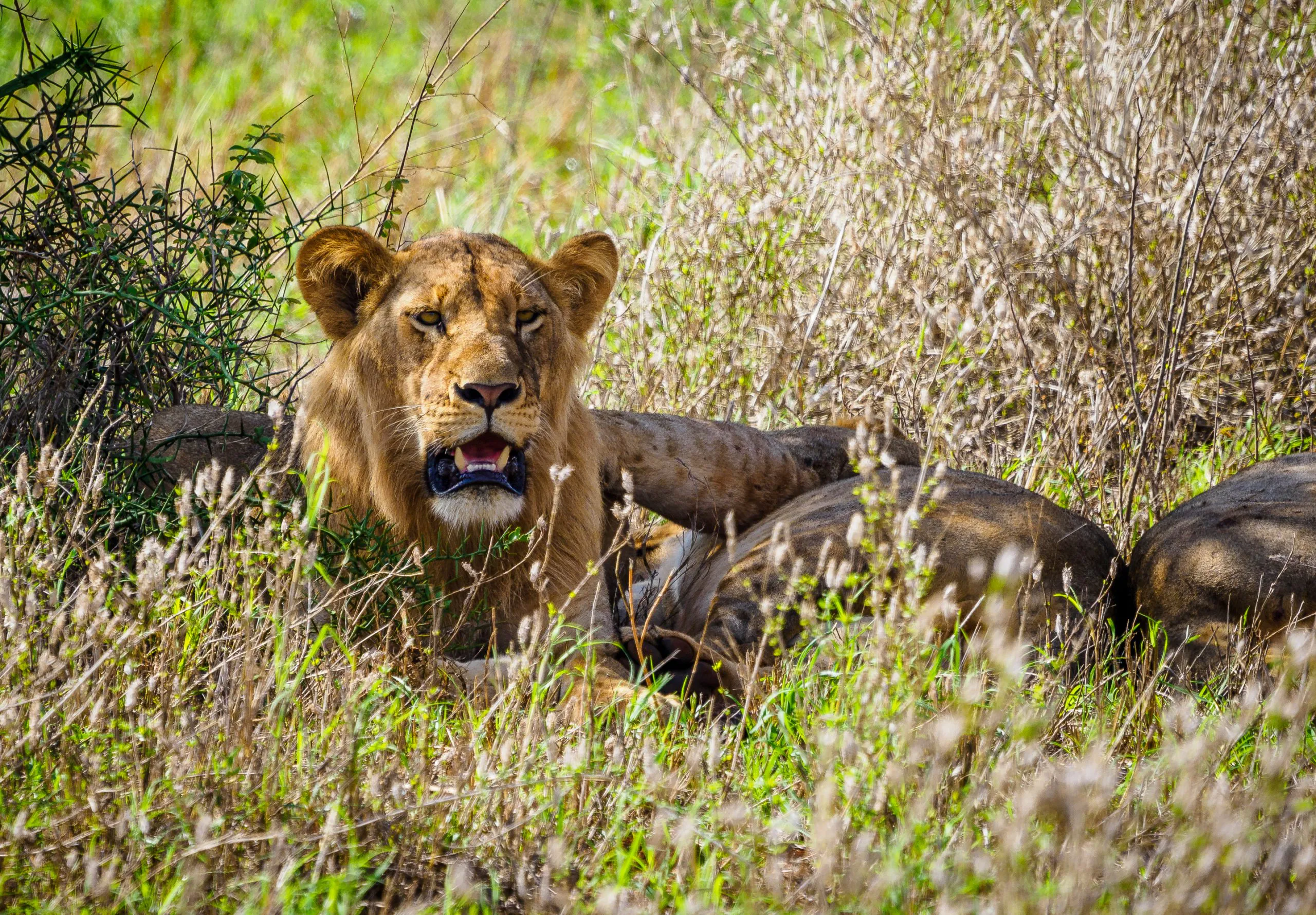
Lions live within Tsavo East and form an important part of the park’s predator community. The broader Tsavo landscape also occupies a unique place in history because of the lions associated with the construction of the Uganda Railway during the late nineteenth century.
Modern lion viewing should not be built around that historical story alone. Tsavo’s lions are free-ranging predators occupying an enormous ecosystem, and they may spend much of the day concealed in vegetation or resting away from accessible roads.
Early morning and late afternoon drives can provide favorable searching conditions because temperatures are cooler. Guides look for tracks, prey reactions, alarm calls, vultures, recent kills, and information from other professional guides.
A lion sighting may involve an individual male, a group of females, cubs, or animals resting near shade and water. Travelers may occasionally observe hunting or feeding, but these behaviors are never guaranteed.
Vehicles must avoid surrounding lions, blocking their movement, crowding cubs, or pressuring resting animals to stand. A peaceful, naturally behaving lion provides a more responsible encounter than one disturbed for photography.
Are Leopards Found in Tsavo East?
Leopards occur in Tsavo East but are among the park’s more elusive predators. Their spotted coats provide excellent camouflage among woodland, rocks, riverine vegetation, and shadows.
Leopards are generally solitary and can be active during the night, early morning, evening, or other cooler periods. They may rest in trees, rocky areas, thickets, or drainage lines during the heat of the day.
Finding one requires patience, guide experience, and considerable luck. A flash of movement across the road, a hanging tail in a tree, alarm calls from monkeys or antelopes, or fresh tracks may reveal their presence.
Visitors should regard a leopard as an exceptional possibility rather than an expected daily sighting. Promising a leopard encounter in such an immense park would be misleading.
Can You See Cheetahs in Tsavo East?
Cheetahs occur in the wider Tsavo ecosystem and may be found in open areas where visibility and suitable prey support their hunting style. However, they are not evenly distributed and are less commonly encountered than elephants or many herbivores.
Unlike lions and leopards, cheetahs depend heavily on speed and generally avoid direct confrontation with stronger predators. They may hunt gazelles, young antelopes, hares, or other appropriately sized prey.
Cheetahs sometimes use termite mounds, rocks, or slight rises to scan the landscape. Their pale coats blend effectively with dry grass and sunlight, making them surprisingly difficult to detect.
A possible cheetah encounter should be treated as a rewarding bonus, not a guaranteed feature of a Tsavo East safari.
Are Hyenas and Wild Dogs Present in Tsavo East?
Spotted hyenas form part of Tsavo East’s carnivore community. They are intelligent and adaptable predators that also scavenge when opportunities arise. Hyenas may be encountered alone, in small groups, near a carcass, or moving between resting and feeding areas.
Striped hyenas have also been associated with Kenya’s dry landscapes but are far more elusive and generally difficult to observe. Any identification should be made carefully rather than assumed from a brief nocturnal sighting.
African wild dogs range across large areas of the greater Tsavo ecosystem. Their extensive movement patterns make encounters highly unpredictable. Travelers should never choose Tsavo East on the assumption that they will certainly see wild dogs.
Wild dogs are highly social, live in packs, and cooperate during movement, hunting, pup rearing, and defense. Encountering a pack is an exceptional conservation and safari experience.
Which Giraffes Live in Tsavo East?
Tsavo East supports Masai giraffes, recognizable by their irregular and jagged coat patterns. Their appearance differs from the sharply defined patches of reticulated giraffes associated with northern Kenya.
Giraffes browse on leaves, shoots, and flowers from trees and shrubs. Their height allows them to reach vegetation unavailable to many other herbivores, although elephants can access or push down higher branches.
Visitors may see solitary males, small associations, females with calves, or larger temporary groups. Giraffe social arrangements are flexible and can change throughout the day.
Tsavo’s open landscapes can provide beautiful photographs of giraffes against red earth, distant hills, riverine woodland, and expansive skies.
Which Zebras Can Be Seen in Tsavo East?
Plains zebras occur in Tsavo East and may be encountered in herds alongside giraffes, antelopes, buffaloes, or other grazing animals. Their black-and-white stripes create one of Africa’s most recognizable wildlife scenes.
Each zebra has an individual stripe pattern. Stripes may help with social recognition and could also contribute to reducing biting-fly pressure and creating visual confusion under certain conditions.
Plains zebras should not be confused with Grevy’s zebras, which are especially associated with northern Kenya. Grevy’s zebras have narrower stripes, white bellies, and larger rounded ears.
Are African Buffaloes Common in Tsavo East?
African buffaloes inhabit Tsavo East, although their distribution varies according to water, grazing, cover, and season. They may occur in substantial herds or in smaller groups.
Older males are sometimes encountered alone or in bachelor groups near water and dense vegetation. These individuals are often called “dagga boys,” a reference to their habit of resting in mud.
Buffaloes demand caution because they are powerful and may react defensively when surprised, injured, cornered, or separated from a group. Visitors should never approach them on foot outside an authorized activity led by qualified personnel.
Which Antelopes Can Be Seen in Tsavo East?
Tsavo East supports an impressive variety of antelopes adapted to open plains, dry scrub, woodland, and riverine habitats. The exact species encountered depends on the section of the park, vegetation, season, water, and time of day.
Lesser Kudu
The lesser kudu is one of Tsavo’s most attractive dry-country antelopes. Males have spiraled horns, while both sexes display pale vertical stripes and large ears. They often favor bushy terrain and can disappear quickly into cover.
Gerenuk
The gerenuk has a long neck and slender body adapted to browsing in dry environments. It may stand on its hind legs to reach leaves above the height available to many other antelopes.
Impala
Impalas are graceful mixed feeders that browse and graze according to available vegetation. Herd composition changes with season, breeding behavior, and habitat conditions.
Waterbuck
Waterbucks are often associated with areas relatively close to dependable water and suitable cover. Their coarse coats and distinctive markings make them easily recognizable.
Eland
The common eland is one of the world’s largest antelopes. Despite its considerable size, it can move rapidly and jump surprisingly well.
Gazelles, Hartebeests and Oryx
Grant’s gazelles, Coke’s hartebeests, and oryx may also be encountered within suitable Tsavo habitats. Identification can be more difficult at long distances, making binoculars extremely valuable.
Dik-Dik
Small dik-diks occur in bushy habitats and frequently form long-term pair bonds. Their small size and preference for cover mean they are easily missed by travelers focused only on large mammals.
What Wildlife Lives Along the Galana River?
The Galana River is one of Tsavo East’s most important ecological features. Its water and riverine vegetation support wildlife in a landscape that can become extremely dry.
Hippos and Nile crocodiles may occur in suitable sections of the river. Elephants, buffaloes, waterbucks, baboons, monkeys, antelopes, and predators may approach the river to drink, feed, rest, or search for prey.
Riverbanks also support kingfishers, herons, storks, African fish eagles, sandpipers, bee-eaters, and numerous other birds. Trees and vegetation beside the water provide shade, nesting places, food, and cover.
Wildlife distribution changes with river levels, rainfall, and season. A known river location does not guarantee that hippos, crocodiles, elephants, or predators will be visible during a particular visit.
Visitors must follow instructions around water. Crocodiles may remain almost completely submerged, while hippos can leave the river and move on land. Walking near the bank without authorization is dangerous.
Can You See Hippos and Crocodiles in Tsavo East?
Hippos and Nile crocodiles inhabit suitable areas of the Galana River and other permanent-water environments. Their visibility depends on water depth, vegetation, temperature, time of day, and disturbance.
Hippos often spend daylight hours in water to protect their skin and regulate temperature. They generally emerge at night to graze and may travel considerable distances over land.
Crocodiles may bask on exposed banks or remain submerged with only their eyes and nostrils visible. Their stillness and camouflage can make them difficult to notice.
Both animals can be dangerous. Visitors should never approach water independently, stand between a hippo and the river, or assume that an apparently empty bank is safe.
Which Monkeys and Baboons Live in Tsavo East?
Olive baboons and vervet monkeys may be encountered in woodland, riverine areas, near camps, and around some visitor facilities. Their intelligence and adaptability allow them to exploit a variety of foods.
Travelers must never feed primates. Feeding encourages animals to associate people and vehicles with food, which can produce aggressive behavior and create long-term management problems.
Food should be stored securely, vehicle windows should not be left open near habituated monkeys, and litter must be disposed of responsibly.
What Smaller Animals Can You See in Tsavo East?
Smaller wildlife adds depth to a Tsavo East safari. Mongooses, jackals, bat-eared foxes, hares, porcupines, genets, civets, honey badgers, servals, caracals, warthogs, and aardvarks may occur within the ecosystem.
Many are nocturnal, shy, widely dispersed, or partially hidden by vegetation. A night drive may improve the chances of seeing nocturnal species only where such activities are legally permitted and conducted by authorized operators.
Travelers should also watch for tracks, droppings, burrows, feeding signs, and calls. A safari becomes more rewarding when it includes evidence of wildlife rather than counting only clearly photographed animals.
What Birds Can You See in Tsavo East?
Tsavo East supports hundreds of bird species associated with dry bushland, grassland, rivers, woodland, rocky formations, and seasonal wetlands. The park can therefore be rewarding for dedicated birdwatchers as well as general safari travelers.
Possible sightings include ostriches, secretary birds, hornbills, bustards, bee-eaters, rollers, starlings, weavers, kingfishers, herons, storks, eagles, vultures, falcons, and other raptors.
Large birds are often the easiest to recognize, but some of the park’s greatest birding diversity comes from smaller species inhabiting trees, shrubs, riverbanks, and grass.
Seasonal migrants add variety during parts of the year. Rainfall also influences nesting, plumage, insect numbers, flowering plants, and water availability.
Travelers interested in birding should request a guide with strong identification skills and bring binoculars. A slower private drive often provides a better experience than a general wildlife drive focused primarily on large mammals.
Are There Reptiles in Tsavo East?
In addition to Nile crocodiles, Tsavo East supports snakes, lizards, tortoises, terrapins, and other reptiles. Many are difficult to observe because they avoid vehicles, blend into their surroundings, or remain active during particular temperatures.
Large monitor lizards may be encountered near water, roads, rocky areas, or woodland. Smaller lizards frequently use sun-warmed surfaces and vegetation.
Snakes should never be approached or handled. When one is encountered, visitors should remain calm, provide space, and allow it to move away naturally.
Which Areas of Tsavo East Are Best for Wildlife?
Galana River
The Galana River supports riverine vegetation, birds, crocodiles, hippos, and visiting terrestrial wildlife. Animal concentrations vary with water and season.
Aruba Dam
Aruba Dam can attract animals and birds, particularly during drier conditions. Water availability and wildlife presence are naturally variable.
Mudanda Rock
Mudanda Rock provides elevated views over the surrounding landscape and a seasonal water catchment. Wildlife may gather below when conditions are favorable.
Lugard Falls
Lugard Falls combines dramatic rock formations with river scenery. The area may support birds, crocodiles, and other wildlife, but visitors must observe all safety restrictions.
The “best” wildlife area changes from day to day. An experienced guide plans routes using current conditions, recent reports, water availability, road access, and animal movement rather than relying on a fixed list.
When Is the Best Time to See Wildlife in Tsavo East?
Tsavo East can be visited throughout the year. Generally drier periods often make wildlife easier to locate because vegetation becomes less dense and animals use dependable rivers, dams, and waterholes.
Dry weather can also produce heat, dust, and dispersed wildlife across the enormous landscape. Popular lodges and key water areas may receive more vehicles during holiday periods.
Greener months bring fresh vegetation, active birdlife, dramatic skies, and attractive landscape photography. Animals may disperse more widely as seasonal water and food become available.
Rainfall patterns are variable, so no month should be described as completely dry or guaranteed to provide ideal road conditions. Travelers should plan around their priorities and remain flexible.
How Many Days Do You Need in Tsavo East?
Two nights provide a useful introduction, usually allowing an arrival drive, a full day of exploration, and a final morning activity. However, the park’s enormous size means a short visit covers only a limited area.
Three nights are better for travelers who want more game drives, birdwatching, photography, or time around the Galana River and major attractions.
Four or more nights allow a slower and more immersive experience. Travelers can also combine Tsavo East with Tsavo West, Amboseli, or the Kenyan coast.
A longer stay does not guarantee more species, but it provides additional opportunities to experience changing light, weather, animal movement, and sections of the park.
Where Should You Stay in Tsavo East?
Tsavo East offers accommodation ranging from campsites and comfortable safari lodges to intimate tented camps and premium properties. The best choice depends on budget, travel style, route, gate, and the areas of the park included in the itinerary.
Some properties overlook seasonal waterholes, rivers, or open landscapes. Wildlife may occasionally be observed from camp, but no lodge can guarantee which animals will arrive.
Location is as important as room design. A poorly positioned lodge can create lengthy transfers and reduce game-viewing time. Travelers should confirm the nearest gate, distances to priority areas, meal plan, game-drive arrangement, electricity, family policy, and included services.
What Should You Pack for a Tsavo East Safari?
Pack breathable clothing in neutral colors, a wide-brimmed hat, sunglasses, sunscreen, insect repellent, comfortable footwear, and a light jacket for cooler morning drives.
Binoculars are especially useful because wildlife may be observed across substantial distances. Photographers should carry a suitable zoom lens, spare batteries, extra memory cards, charging equipment, and protection from red dust.
A reusable water bottle supports hydration during warm conditions. Essential medication, travel documents, insurance details, and valuable equipment should remain accessible.
Travelers using light aircraft must confirm current baggage limits and may be required to use soft-sided luggage.
How Can You View Tsavo East Wildlife Responsibly?
Responsible viewing protects animals and improves the quality of the safari. Vehicles should maintain suitable distances, remain on authorized tracks, avoid blocking movement, and reduce noise around wildlife.
Drivers must never chase animals, pressure predators to hunt, surround a sighting, block access to water, or separate elephants and other herd animals.
Feeding wildlife is prohibited and harmful. Food conditioning can make animals aggressive, dependent, or vulnerable to future conflict.
Travelers should avoid sharing sensitive real-time wildlife locations where doing so could increase crowding or security risks. All litter must leave the park or enter designated disposal systems.
Important expectation: No ethical safari operator can guarantee a particular species, close encounter, hunt, road crossing, or herd size. The excitement of Tsavo East comes from observing wildlife behaving naturally across a vast wilderness.
Can Tsavo East Be Combined with Other Destinations?
Tsavo East combines particularly well with Tsavo West. Together, the parks deliver open plains, river wildlife, red elephants, volcanic terrain, springs, woodland, hills, and geological attractions.
Amboseli can be added for elephant viewing, wetlands, open plains, and possible Mount Kilimanjaro scenery. Mountain visibility remains weather-dependent.
Tsavo East’s location also makes it ideal for a bush-and-beach holiday. Travelers can continue toward Mombasa, Diani, Watamu, or another coastal destination after the safari.
Explore additional options through the Ngeye Kenya national parks guide or browse our African safari packages.
Why Choose Ngeye Uganda Tours for a Tsavo East Safari?
Ngeye Uganda Tours designs personalized East African safaris according to travel dates, available time, accommodation preference, budget, photography interests, and desired pace.
Our planning considers realistic road times, gate selection, lodge location, seasonal conditions, game-drive schedules, and possible combinations with Tsavo West, Amboseli, Nairobi, or Kenya’s coast.
Experienced guides interpret animal behavior, habitats, tracks, bird calls, seasonal changes, and conservation issues while following responsible wildlife-viewing practices.
Learn more about Ngeye Uganda Tours or contact our specialists to begin planning your customized Kenya wildlife journey.
Plan Your Tsavo East Wildlife Safari
Search for red elephants, lions, giraffes, zebras, river wildlife, dry-country antelopes, and remarkable birds across one of Kenya’s greatest wilderness landscapes.
Frequently Asked Questions About Wildlife in Tsavo East
What animals can I see in Tsavo East?
Possible sightings include African savanna elephants, lions, buffaloes, giraffes, zebras, hippos, crocodiles, antelopes, hyenas, jackals, cheetahs, leopards, monkeys, baboons, reptiles, and numerous bird species.
Are elephants easy to see in Tsavo East?
Elephants are strongly associated with Tsavo East and may be encountered during game drives. However, their location and herd size change according to water, food, season, and movement.
Why do Tsavo elephants look red?
They have naturally gray skin but acquire a red appearance after dust bathing in Tsavo’s iron-rich soil.
Can I see lions in Tsavo East?
Yes, lions live in Tsavo East. Sightings are unpredictable because the park is enormous and lions may remain concealed in vegetation or rest away from accessible roads.
Are leopards found in Tsavo East?
Yes. Leopards inhabit Tsavo East but are elusive, well camouflaged, and generally more difficult to observe than elephants or plains herbivores.
Are rhinos found in Tsavo East?
Rhinos form part of the wider Tsavo conservation story, but travelers should not expect routine rhino sightings in Tsavo East. Tsavo West is more strongly associated with protected black-rhino conservation areas.
What wildlife lives in the Galana River?
Suitable sections of the Galana River may support hippos, Nile crocodiles, fish, waterbirds, elephants, buffaloes, waterbucks, monkeys, baboons, and other animals visiting the river.
What is the best time to see wildlife in Tsavo East?
Wildlife can be observed throughout the year. Drier periods may concentrate animals near dependable water, while greener periods provide lush scenery, birding activity, and broader wildlife distribution.
How many days should I spend in Tsavo East?
Two nights provide an introduction, but three or four nights allow more game drives and a better appreciation of the park’s enormous scale.
Are wildlife sightings guaranteed in Tsavo East?
No. Tsavo East is a vast natural ecosystem containing free-ranging animals. Experienced guides improve the chances of locating wildlife, but specific sightings and behaviors cannot be guaranteed.